Supply Chain Due Diligence Regulations Explained

Supply chain due diligence regulations establish mandatory legal frameworks requiring large enterprises to identify, prevent, and remediate human rights violations and environmental degradation across their global supplier networks. Governed by rules like the European Union Corporate Sustainability Due Diligence Directive, compliance requires verified tracking of upstream production operations to mitigate systemic legal, financial, and regulatory liabilities.
What Are Supply Chain Due Diligence Regulations?
Supply chain due diligence regulations are legally binding statutes that transfer accountability for environmental and human rights impacts directly to the importing corporations. These statutory frameworks compel multi-national enterprises to implement comprehensive, risk-based vetting programs across their entire vendor networks. By transforming voluntary ethical codes into hard legal mandates, international legislative bodies aim to establish harmonized standards for fair labor, climate resilience, and ecosystem protection.
The global enforcement landscape experienced a major structural shift with the formal enactment of the European Union Corporate Sustainability Due Diligence Directive (CSDDD). Rather than restricting oversight to immediate tier-one suppliers, these modern regulations govern the entire upstream and downstream chain of activities. Global procurement teams must systematically audit factory floor conditions, verify chemical containment protocols, and track raw material sourcing origins to maintain market eligibility.
Which Enterprises Are Subject to the Amended CSDDD Framework?
The amended CSDDD framework targets large European Union limited liability companies and non-EU multi-nationals generating substantial turnover within the single market. Following recent legislative adjustments under the Omnibus I simplification initiatives, the operational baseline has been substantially modified to focus strictly on major corporate entities. These amendments aim to balance supply chain competitiveness with robust environmental accountability.
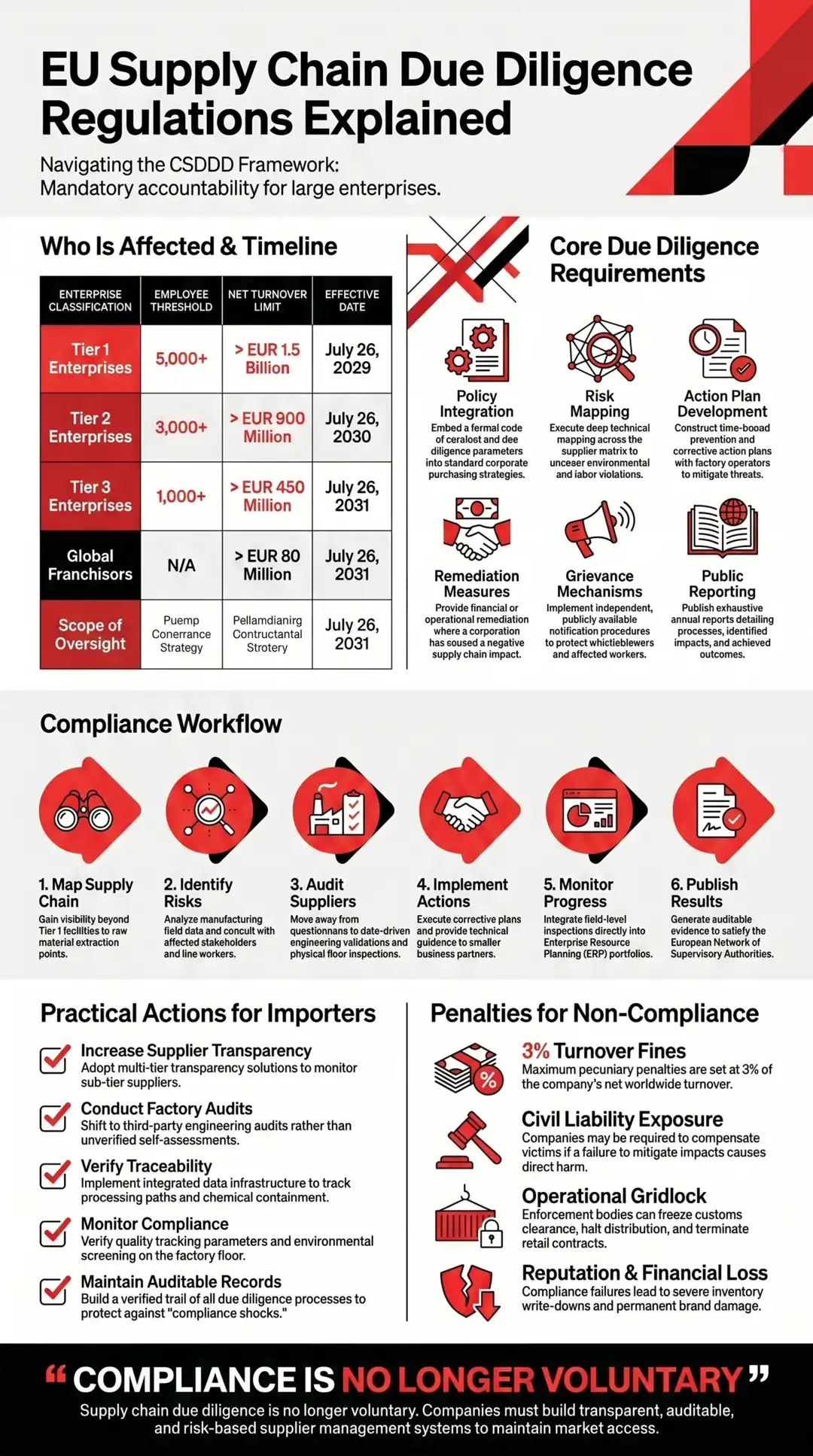
To clarify corporate exposure across individual asset thresholds, the phased implementation schedules are organized in the analytical structure below:
| Corporate Classification Tier | Employee Threshold Baseline | Worldwide Net Turnover Limit | Direct Enforcement Effective Date |
| Tier 1 Enterprises | Exceeding 5,000 employees | Greater than EUR 1.5 billion | July 26, 2029 |
| Tier 2 Enterprises | Exceeding 3,000 employees | Greater than EUR 900 million | July 26, 2030 |
| Tier 3 Enterprises | Exceeding 1,000 employees | Greater than EUR 450 million | July 26, 2031 |
| Global Franchisors | Not applicable | Greater than EUR 80 million | July 26, 2031 |
Recent adjustments finalized under the Directive (EU) 2026/470 amending regulatory requirements officially extended the national transposition deadline for EU member states to July 26, 2028. This temporary postponement gives cross-border enterprises additional time to upgrade their tracking infrastructure and align corporate policies. However, smaller sub-contractors outside direct scope will face immediate downstream requirements as primary buyers begin cascading compliance clauses through procurement agreements.

What Structural Obligations Do Sourcing Entities Face Under the New Mandates?
Sourcing entities face strict administrative obligations that require them to embed risk-based due diligence directly into their core corporate strategies, operations, and risk management portfolios. Multi-nationals must establish verified, ongoing procedures to screen their subsidiaries and manufacturing partners for potential non-conformities. The focus must remain on generating auditable evidence rather than executing simple paper-based checklist evaluations.
According to institutional compliance principles outlined by the European Commission corporate sustainability due diligence standards, corporate compliance programs must prioritize six distinct operational categories:
-
Policy Integration: Integrating a formalized code of conduct and due diligence parameters into standard corporate purchasing strategies.
-
Risk Mapping Procedures: Executing deep visual and technical mapping across the supplier matrix to uncover environmental and labor violations.
-
Action Plan Development: Constructing time-bound prevention and corrective action plans with factory operators to mitigate identified threats.
-
Remediation Mechanisms: Providing legitimate financial or operational remediation where a corporation has caused or jointly caused a negative supply chain impact.
-
Grievance Portals: Implementing an independent, publicly available notification mechanism and complaints procedure to protect whistleblowers.
-
Public Performance Statements: Publishing an exhaustive annual report detailing all due diligence processes, identified impacts, and achieved outcomes.
Furthermore, corporate entities must take appropriate measures to ensure meaningful stakeholder engagement throughout the assessment loop. This requires direct consultation with affected line workers, local communities, and employee representatives when analyzing manufacturing field data. By tracking these data points systematically, organizations can isolate environmental vulnerabilities before they disrupt global distribution systems.
What Financial and Legal Penalties Exist for Supply Chain Compliance Failures?
Supply chain compliance failures trigger severe financial penalties and extensive civil liabilities enforced directly by designated national supervisory authorities. Legislative bodies have explicitly designed these penalties to prevent companies from treating compliance as an arbitrary administrative expense. The structural objective is to ensure that comprehensive risk mapping remains financially superior to operational neglect.
For serious environmental or human rights transgressions, the maximum limit for pecuniary penalties is set at 3% of the company’s net worldwide turnover. For a multi-national corporation operating at scale, a single non-compliance sanction can translate into tens of millions of dollars in direct losses. In addition to state-level administrative fines, businesses face independent civil liability lawsuits requiring them to compensate victims if a failure to mitigate adverse impacts causes direct harm.
Supervisory networks operate across a unified European Network of Supervisory Authorities to ensure a coordinated enforcement approach. This administrative alignment removes regulatory gaps and ensures that corporations face identical enforcement pressure regardless of their primary port of entry. Consequently, centralized corporate legal teams must manage supply chain risk as a uniform compliance mandate across all operational regions.
The operational damages associated with regulatory enforcement often exceed the raw financial fines. Regulatory enforcement bodies possess the power to issue injunctive orders that freeze customs clearance, halt distribution loops, and terminate active retail contracts. These gridlocks result in severe inventory write-downs and permanent brand reputation damage across global single markets.
How Can Transnational Corporations Operationalize Due Diligence Protocols?
Transnational corporations can operationalize due diligence protocols by establishing multi-tier supply chain transparency solutions, updating supplier agreements, and executing regular on-site verification audits. Organizations must shift away from unverified vendor questionnaires and adopt data-driven engineering validations. Gaining deep visibility requires a proactive investment in structural compliance technologies and independent field assessments.
To minimize friction when dealing with overseas subcontractors, procurement teams must understand the supply chain value chain cap limitations that protect small midcaps from excessive data requests. Instead of overburdening smaller business partners with fragmented documentation requests, primary buyers should offer technical guidance and model contractual clauses. This collaborative framework ensures legal certainty while building resilient, long-term manufacturing partnerships.
Enterprise-grade transparency solutions allow procurement teams to monitor sub-tier suppliers beyond immediate tier-one facilities. Tracking raw material extraction, processing paths, and chemical containment loops requires integrated data infrastructure. Organizations that integrate field-level inspections directly into their enterprise resource planning portfolios achieve superior compliance readiness.
Successful enterprise risk management requires executing physical floor inspections and verifying quality tracking parameters on the factory floor. By combining regular quality audits with formal environmental screening, global brands can build auditable verification trails. This objective approach protects corporate operations from compliance shocks while elevating product quality across competitive manufacturing ecosystems.
Institutional Supply Chain Risk Management
Defending global logistics networks against escalating regulatory friction demands expert field oversight, independent auditing, and structured compliance data management. Relying on supplier self-assessments or unverified declarations exposes large corporations to severe legal penalties, custom gridlocks, and operational vulnerabilities.
At VIS Global Quality Control, we translate complex international environmental and human rights directives into transparent, auditable on-site verification solutions. Our senior engineering division delivers rigorous third-party factory audits, component traceability validations, and compliance diagnostic assessments across major global manufacturing hubs.
Ensure your cross-border supply chain satisfies the rigorous demands of modern regulatory frameworks. Contact our corporate advisory team today at info@visgl.com or visit VIS Global Quality Control to establish an institutional-grade supply chain verification program.