
 Info@visgl.com













Inspection News
Golf Product Inspection: What Global Buyers Still Underestimate About Quality Risks in the Golf Industry
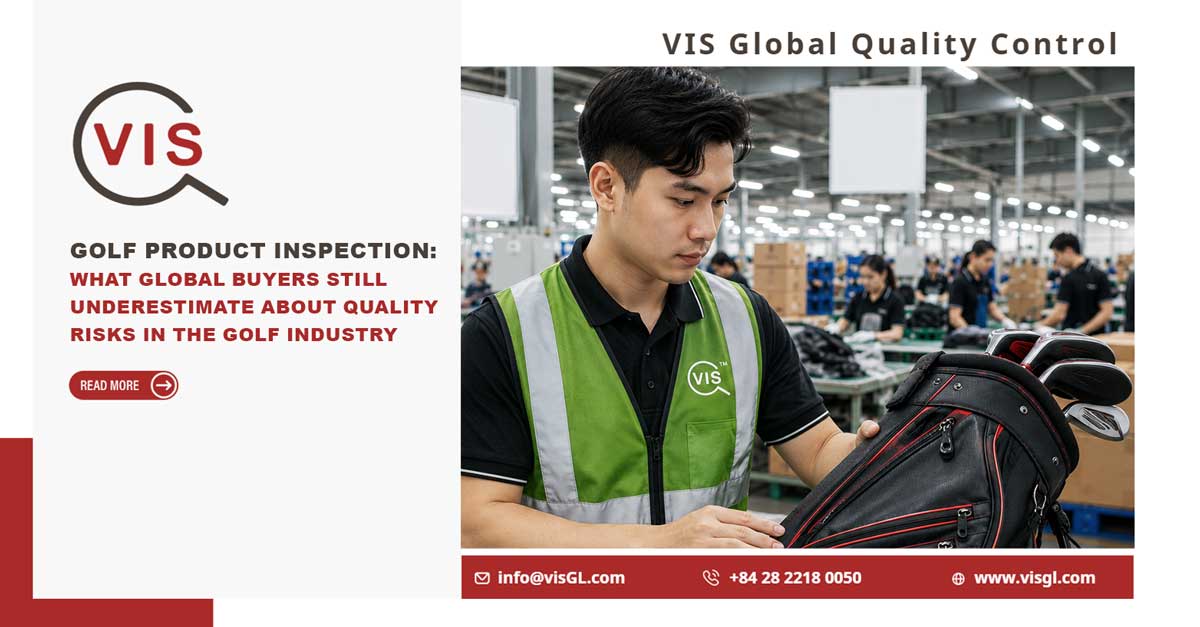
The global golf industry has evolved far beyond a niche sporting goods market. Today, golf equipment manufacturing is part of a highly competitive international supply chain stretching across Vietnam, China, and other Asian production hubs.
For buyers, importers, and golf brands, the challenge is no longer only about finding factories with competitive pricing. The real challenge is maintaining consistent product quality while production scales quickly across multiple suppliers.
At VIS Global Quality Control, our inspectors frequently see the same pattern inside golf equipment factories:
The most expensive quality problems are rarely the obvious ones.
In many cases, products look acceptable during production. Packaging appears clean, assembly lines move efficiently, and shipment schedules remain on track. However, small inconsistencies hidden inside the manufacturing process often become serious customer complaints after products arrive overseas.
A slightly misaligned golf grip. Weak stitching on a travel golf bag. A coating issue that only appears after repeated use. These details may seem minor inside a factory environment, but they directly affect customer experience and brand reputation once products reach retail markets.
That is why professional golf product inspection services have become increasingly important for global sourcing operations.
Why Golf Products Require Specialized Quality Inspection
Golf equipment is different from many standard consumer products because performance consistency matters.
A golfer immediately notices when a club feels unbalanced during a swing or when a golf bag fails during travel. Unlike low-involvement products, golf equipment is closely connected to user experience, durability, and trust in the brand itself.
This creates much higher expectations for manufacturing consistency.
Inside factories, production teams often focus heavily on output volume and shipment deadlines. Buyers, however, focus on long-term quality stability and customer satisfaction.
That gap in priorities is exactly where third-party inspection becomes valuable.
Independent inspectors provide objective visibility into actual production quality before goods leave the factory.
What VIS Inspectors Commonly Find During Golf Product Inspections
From the outside, many factories appear highly organized. Production lines move quickly, workers follow procedures, and finished products look visually acceptable.
But inspections often reveal another layer of operational reality.
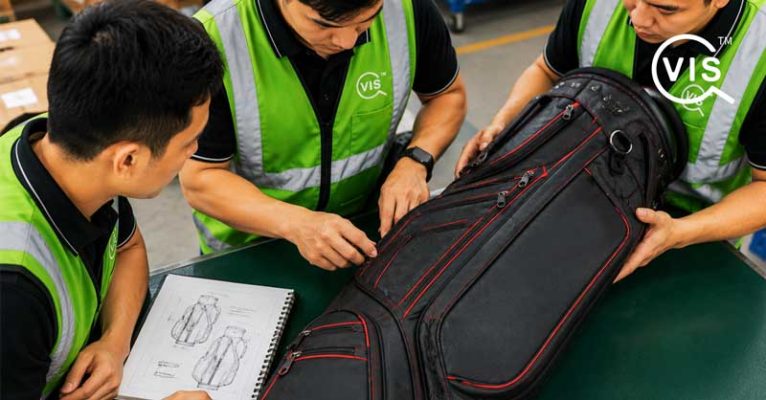
During golf club inspections, VIS teams frequently identify issues such as:
- shaft alignment deviation
- inconsistent clubhead balance
- grip installation inconsistency
- coating defects
- assembly pressure variation
- logo positioning errors
For golf bags and accessories, common problems include:
- stitching weakness
- zipper durability failures
- unstable support structures
- dimensional inconsistency
- material peeling
- packaging compression risks during export
Interestingly, many of these issues are not caused by negligence. They are usually the result of production scaling pressure.
As factories increase output, maintaining stable workmanship consistency becomes significantly more difficult, especially during peak manufacturing seasons.
Experienced inspectors understand that quality control is not only about checking finished products. It is about understanding manufacturing behavior, production flow, and supplier risk patterns.
Why Final Random Inspection Alone Is Often Not Enough
One of the most common sourcing mistakes buyers make is relying only on final inspection before shipment.
At that stage, production is already completed. If major quality issues are discovered too late, buyers face difficult decisions:
Should the shipment be delayed?
Should defective products be accepted?
Can the factory realistically complete rework on time?
Every option increases operational costs.
This is why experienced sourcing teams now use layered quality control strategies instead of depending on a single inspection stage.
Professional inspection programs often include:
- during production inspection
- pre-shipment inspection
- supplier factory audits
- container loading supervision
The goal is not simply to “find defects.”
The goal is to reduce sourcing uncertainty before quality problems become expensive supply chain issues.
Why Vietnam Is Becoming a Major Golf Manufacturing Hub
Vietnam has rapidly become an important manufacturing location for sporting goods and golf-related products.
Many international buyers are diversifying sourcing operations beyond China while searching for:
- production flexibility
- competitive manufacturing costs
- export capability
- long-term supply chain stability
As more golf production moves into Vietnam, quality management becomes even more important.
Not every supplier operates with the same production maturity or quality systems. Some factories have extensive export experience, while others are still adapting to international buyer expectations.
This is why supplier audits and independent inspections are becoming standard practice for many global sourcing teams operating in Vietnam and Southeast Asia.
At VIS Global Quality Control, our teams support buyers across Vietnam, China, Cambodia, Thailand, and other Asian manufacturing regions through independent inspection services designed to improve sourcing transparency and reduce operational risk.
What Professional Golf Product Inspection Actually Includes
Many people assume inspection simply means visually checking products before shipment. In reality, professional golf product inspection is far more structured.
Inspectors evaluate not only cosmetic appearance, but also:
- workmanship consistency
- structural durability
- packaging protection
- dimensional accuracy
- material conformity
- labeling compliance
- export readiness
For golf clubs, even small balance inconsistencies can affect customer perception.
For golf bags, durability testing becomes critical because products experience heavy transportation stress during travel and export handling.
Packaging itself is another commonly underestimated risk area. Products may pass factory inspection but still arrive damaged overseas because carton protection or pallet loading standards were insufficient.
This is why experienced inspection teams evaluate the entire shipment readiness process, not only the product itself.
Why More Global Buyers Use Third-Party Inspection Services
Global sourcing environments have become far more complex than they were a decade ago.
Production moves faster. Supply chains are more fragmented. Retail quality expectations are higher than ever.
As a result, buyers increasingly rely on independent inspection partners to provide objective production visibility inside factories.
Third-party inspection services help buyers:
- reduce supplier blind spots
- improve accountability
- identify risks earlier
- strengthen shipment decisions
- protect brand reputation
- reduce costly post-shipment disputes
Most importantly, independent inspections create transparency that internal factory reporting alone often cannot fully provide.
For overseas buyers managing suppliers remotely, this visibility becomes extremely valuable.
The Future of Golf Product Quality Control
The inspection industry itself has changed significantly over recent years.
Previously, inspections were often viewed simply as a shipment approval step. Today, experienced sourcing teams see inspections as part of broader supply chain risk management.
The objective is no longer just passing inspection.
The objective is preventing quality failures before products reach the market.
As golf equipment manufacturing continues expanding across Asia, maintaining stable product consistency will become even more important for global brands.
Factories can scale production quickly. Maintaining consistent quality at scale is much harder.
That is why professional third-party inspection services are becoming an essential part of modern golf sourcing strategies.
Frequently Asked Questions About Golf Product Inspection
What is golf product inspection?
Golf product inspection is a third-party quality control process used to verify the workmanship, functionality, consistency, and export readiness of golf equipment before shipment.
Why do golf products require specialized inspection?
Golf products directly affect player experience and product performance. Small inconsistencies in balance, grip installation, stitching quality, or assembly can create customer dissatisfaction and warranty issues.
Why do buyers use third-party inspection instead of factory self-QC?
Third-party inspections provide independent visibility and objective reporting beyond internal factory quality controls.
Why is Vietnam important for golf product manufacturing?
Vietnam has become a growing manufacturing hub for golf equipment and sporting goods due to expanding industrial capability and supply chain diversification.
Need Professional Golf Product Inspection Services in Asia?
VIS Global Quality Control supports golf brands, importers, sourcing offices, and retailers through:
- golf product inspections
- supplier audits
- during production inspections
- pre-shipment inspections
- sporting goods quality control
- container loading supervision
Our inspection network covers Vietnam, China, Cambodia, Thailand, and major manufacturing regions across Asia.
With years of operational inspection experience inside factories, VIS helps buyers reduce sourcing risks while improving manufacturing transparency and product consistency.
