
 Info@visgl.com













Inspection News
How Quality Problems Escalate from Factory to End Customer
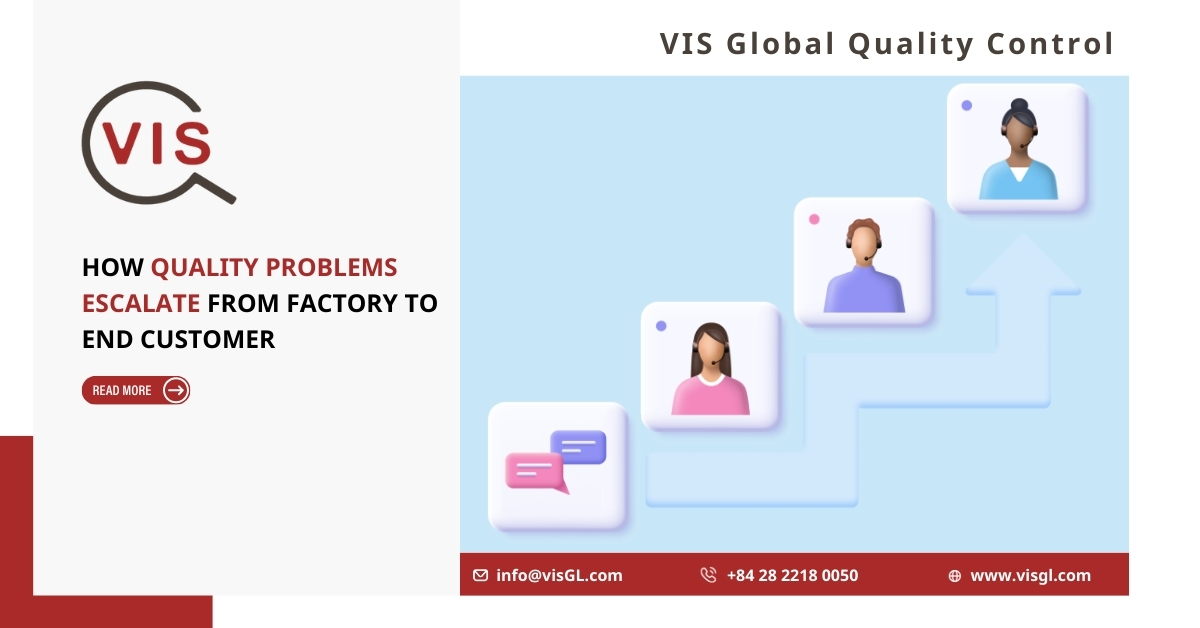
Quality problems rarely appear suddenly at the customer level. In most cases, escalation begins quietly inside the factory—through small process deviations, material inconsistencies, or overlooked inspection gaps. When these early warning signs are missed, minor defects can travel through the supply chain and eventually surface as customer complaints, shipment disputes, or even reputational damage.
At VIS Global Quality Control, we see this pattern repeatedly across manufacturing hubs in Asia. Escalation is not caused by a single defective product. It is the result of delayed detection, fragmented responsibility, and insufficient communication between production teams, suppliers, and brand owners.
Understanding Quality Escalation in Manufacturing
In quality management, escalation refers to the point where routine controls fail and an issue requires intervention from higher authority, technical specialists, or leadership teams. What starts as a localized production defect can quickly evolve into a customer experience crisis if not contained early.
Factories often operate under tight schedules and output pressure. When equipment drifts, raw materials vary, or specifications are misunderstood, defects emerge. If inspection standards are unclear or sampling levels are too light, these problems escape internal controls. Once defective goods are shipped, tracing affected batches becomes harder, costs increase, and customer confidence begins to erode.
By the time complaints reach customer service, the issue has already crossed multiple operational boundaries. Quality incidents then involve sourcing, engineering, logistics, and commercial teams—turning a technical defect into a cross-functional escalation.
Why Quality Problems Escalate So Quickly
Quality escalations accelerate when accountability is unclear and no single owner drives resolution. Information often moves slowly between factories and brand teams, creating delays in containment. In some production environments, defects are quietly corrected on the surface rather than reported transparently, allowing deeper issues to persist. Escalation becomes even more severe when internal thresholds are vague—teams hesitate over who should act, when leadership should intervene, and how serious a problem must be before decisive action is taken.
Customer frustration grows when updates are delayed or incomplete. Without clear communication, buyers interpret silence as negligence, even when teams are actively working behind the scenes. Over time, quality incidents stop being operational problems and become trust issues that threaten long-term relationships.
From Factory Floor to End Customer: The Escalation Journey
Most quality escalations follow a predictable path. A deviation occurs during production. The issue escapes routine inspection. Defective goods move into distribution. Complaints begin to surface. Formal escalation procedures activate. Finally, senior management becomes involved as financial risk, customer churn, or brand exposure increases.
Each stage adds complexity and cost. What could have been resolved through early inspection now requires returns, rework, expedited shipping, or compensation. In severe cases, safety concerns or regulatory exposure may arise, amplifying business impact.

Building an Effective Escalation Framework
A structured escalation framework allows manufacturers to respond consistently and confidently when issues arise. Clear severity levels help teams distinguish between isolated defects and business-critical incidents. Early response protocols ensure rapid acknowledgment, immediate containment, and transparent communication with customers.
Before conducting deep root-cause analysis, organizations must stabilize the situation through shipment holds, targeted sorting, intensified inspections, and verification of affected stock. Only after product flow is secured should teams investigate underlying causes.
Long-term resolution depends on disciplined corrective and preventive actions. Root causes must be clearly identified, corrective measures implemented, preventive controls established, and results verified through follow-up inspections or production monitoring. Post-resolution communication is equally important. Explaining what happened, what changed, and how recurrence will be prevented helps restore customer confidence.
Preventing Escalation Through Proactive Inspection
The most effective way to reduce quality escalation is to stop problems upstream. Supplier audits confirm production capability before volume orders begin. Pre-production inspections validate materials and specifications. During-production inspections detect process drift while corrections are still affordable. Pre-shipment inspections block defects from leaving the factory, and container loading supervision prevents quantity or packaging errors.
When applied consistently, these inspection checkpoints transform quality control from a compliance task into a risk management system that protects end customers.

Measuring Quality Escalation Performance
Manufacturers should track escalation as a core operational metric. Response time, containment speed, repeat defect rates, complaint trends, and cost of poor quality all provide insight into system effectiveness. These indicators highlight where preventive investment delivers the greatest return and where internal processes need strengthening.
Final Thoughts: Stop Escalation at the Source
Quality escalation is rarely about a single mistake. It is driven by weak detection, unclear ownership, slow communication, and insufficient prevention. Companies that succeed in minimizing escalation focus on early intervention, transparent workflows, and continuous improvement across their supply chains.
VIS Global Quality Control supports brands and manufacturers with inspection services, supplier verification, and on-the-ground quality execution throughout Asia. By identifying risks early and strengthening production controls, we help businesses reduce customer complaints, protect brand reputation, and build resilient global supply chains.
