
 Info@visgl.com












Regulations News
ISO 9001:2026 Update – Key Changes Organizations Need to Know
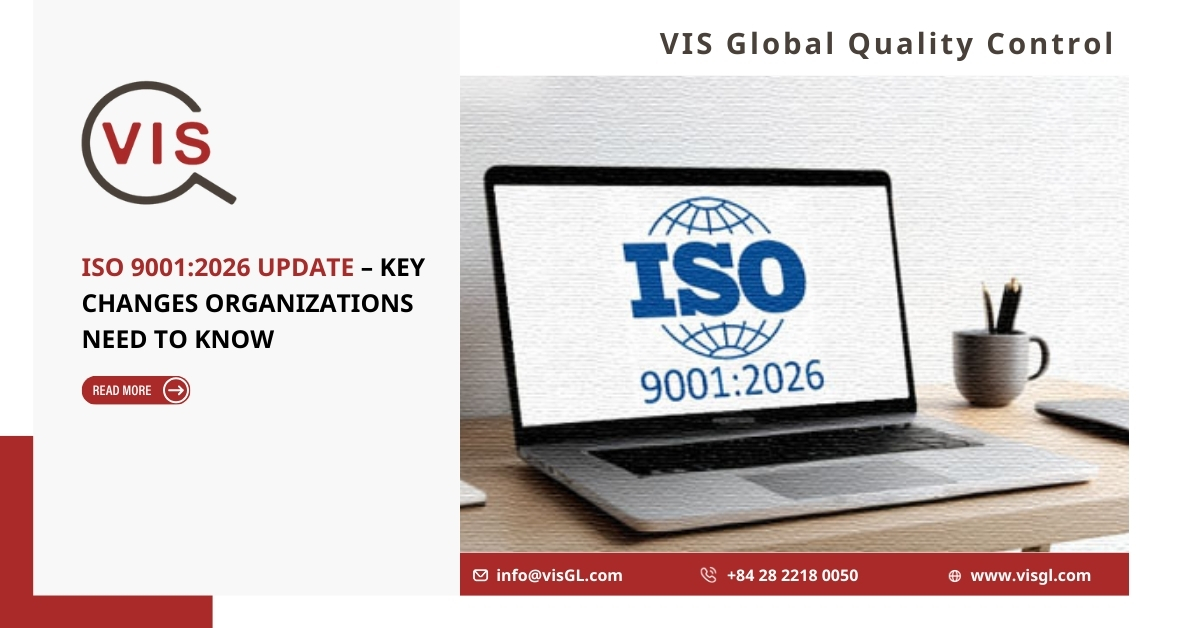
ISO 9001 is the most widely recognized quality management standard globally, providing a framework for organizations to consistently deliver products and services that meet customer and regulatory requirements. As global markets, supply chains, and business models continue to evolve, the upcoming ISO 9001:2026 revision is designed to ensure the standard remains relevant, practical, and aligned with modern operational realities.
The 2026 update does not replace the fundamental principles of ISO 9001. Instead, it refines and strengthens existing requirements, offering greater clarity, stronger integration with business strategy, and improved alignment with today’s risk-driven and digital operating environments.
Key Drivers Behind the ISO 9001:2026 Update
The revision reflects major shifts in how organizations operate, including increased supply chain complexity, digital transformation, higher stakeholder expectations, and growing emphasis on resilience and sustainability. ISO 9001:2026 aims to better support organizations in managing uncertainty, maintaining consistent quality, and improving long-term performance.
Rather than introducing entirely new concepts, the update clarifies expectations and reinforces areas that have proven critical to effective quality management.
Major Areas of Change
Deeper Understanding of Organizational Context
Organizations will be expected to demonstrate a more structured and evidence-based analysis of internal and external factors that affect their quality management system. This includes market conditions, regulatory environments, supply chain dependencies, and stakeholder needs. Quality management is increasingly positioned as an integral part of overall business strategy rather than a standalone system.
Stronger and More Practical Risk-Based Thinking
Risk-based thinking, already a core concept, will become more explicit in the 2026 revision. Organizations must show how risks and opportunities are identified, assessed, prioritized, and addressed in daily operations. This proactive approach supports better decision-making, improved process stability, and stronger customer confidence.
Enhanced Leadership Accountability
Top management involvement remains essential, but ISO 9001:2026 strengthens expectations around leadership accountability. Leaders are expected to take clearer ownership of quality objectives, performance monitoring, and continual improvement, embedding quality principles into organizational culture and strategic decisions.
Alignment With Digital and Modern Work Practices
The revised standard better reflects digital documentation, electronic records, data-driven decision-making, and remote operations. It allows greater flexibility in how documented information is managed, while still ensuring traceability, integrity, and control.
Greater Focus on Supply Chain and External Providers
Given the increasing complexity and risk within global supply chains, ISO 9001:2026 places additional emphasis on the evaluation, monitoring, and control of external providers. Organizations must demonstrate effective oversight of suppliers, subcontractors, and outsourced processes that impact product and service quality.

Clearer Language and Reduced Ambiguity
Several clauses will be refined to reduce inconsistent interpretation across industries and certification bodies. Clearer wording improves understanding, simplifies implementation, and supports more consistent audit outcomes worldwide.
Summary Table: Key Changes in ISO 9001:2026
| Area | ISO 9001:2015 | ISO 9001:2026 (Updated Focus) |
| Purpose of revision | Established risk-based QMS framework | Improved relevance to modern business, supply chain, and digital environments |
| Organizational context | General identification of context | Deeper, structured analysis of internal and external factors |
| Risk-based thinking | Introduced and encouraged | More explicit, systematic, and proactive application |
| Leadership role | Overall responsibility for QMS | Stronger accountability and strategic integration |
| Supplier & external provider control | Basic control based on impact | Enhanced evaluation, monitoring, and risk management |
| Documented information | Flexible paper or electronic records | Better alignment with digital systems and data integrity |
| Standard language | Some clauses open to interpretation | Clearer wording and reduced ambiguity |
| Integration with business | QMS as a management system | Quality embedded into operations and decision-making |
| Impact on certified organizations | Maintain certification cycle | Formal transition period with recommended early preparation |
What This Means for Organizations
Organizations certified to ISO 9001 will be given a defined transition period once the 2026 version is officially published. While immediate recertification will not be required, early preparation through gap analysis and system review is strongly recommended.
Companies with mature quality systems, strong leadership engagement, effective risk management, and robust supplier control will find the transition smoother and more efficient.

How VIS Global Quality Control Adds Value
At VIS Global Quality Control, we help organizations align inspection, supplier evaluation, and quality control activities with evolving ISO 9001 requirements. Our services support businesses in identifying quality risks early, strengthening supply chain oversight, and maintaining compliance in a changing regulatory and operational landscape.
By understanding and preparing for ISO 9001:2026 in advance, organizations can turn compliance into a strategic advantage—enhancing operational resilience, customer trust, and long-term performance.
